Neuroscience-Inspired Encoding and Learning for Robust Representations
Apr – Aug 2025 · OIST, Okinawa, Japan · Supervisor: Prof. Makoto Yamada
- Robustness
- Self-supervised learning
- Neuroscience-inspired
Research internship in the Machine Learning and Data Science Unit of the Okinawa Institute of Science and Technology, supervised by Prof. Makoto Yamada.
I explored the frontier between robust representation learning and neuroscience-inspired encoding and learning. Deep vision encoders tend to overfit and are fragile to adversarial perturbations, which is a major obstacle in domains such as brain imaging where datasets are small, noisy and highly variable. We studied whether building robustness into the architecture and the learning rule could replace costly defences such as adversarial training or heavy data augmentation:
- Artificial Kuramoto Oscillatory Neurons (AKOrN) model neurons as coupled oscillators whose synchronisation binds features together;
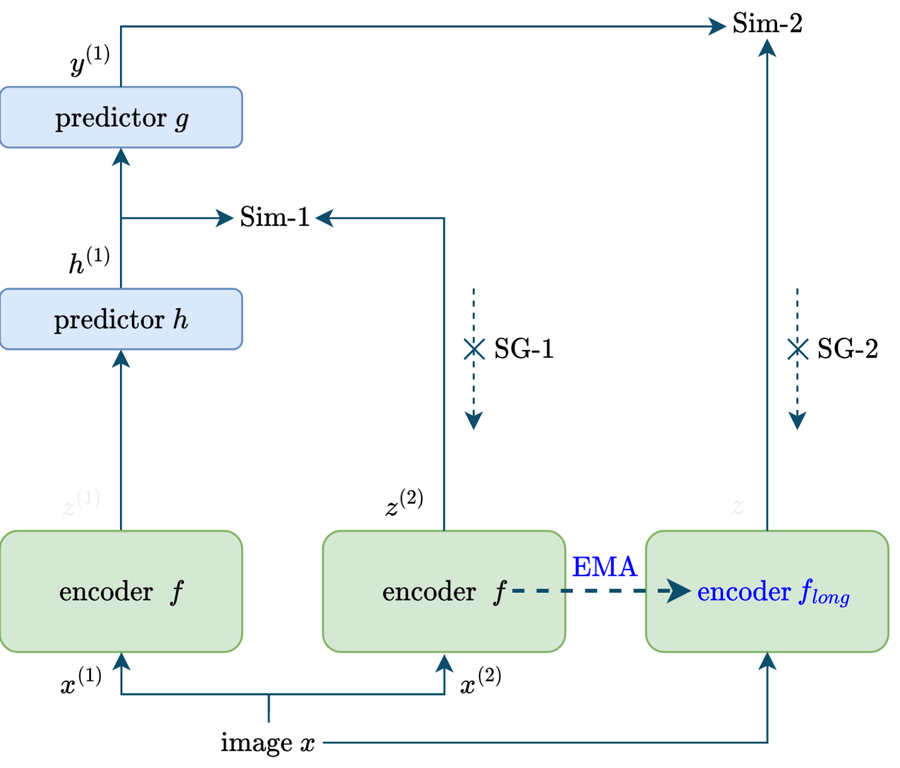
- PhiNet is a non-contrastive self-supervised method inspired by the hippocampus and temporal prediction theory.
We evaluated AKOrN encoders trained with contrastive (SimCLR) and non-contrastive (BYOL, SimSiam, PhiNet) objectives under adversarial attacks on CIFAR-10.
📄 Publications:
- Neuroscience-Inspired Encoding and Learning: A Path to Robust Representation Learning — WiML Workshop @ NeurIPS 2025.
- Neither Adversarial Training Nor Purification: Emergent Adversarial Robustness from Oscillatory Predictive Learning — arXiv preprint, 2026.